Art Deco or Mid-Century Modern? How to Tell Them Apart, and How to Mix Both
Art Deco and Mid-Century Modern are the two styles designers reach for most when they want a room to feel considered rather than decorated. They are often confused, yet they come from different decades and answer different questions. Art Deco celebrates glamour, symmetry and rich materials. Mid-Century Modern favors ease, clean function and the warmth of natural wood. Used together with a little discipline, they make some of the most compelling interiors we see.
If you are deciding which direction suits your home, or wondering whether you can have both, this guide sets out how to tell them apart at a glance, what each does best, and how to combine them without the room losing its voice.
The difference at a glance
| Art Deco | Mid-Century Modern | |
|---|---|---|
| Era | 1920s to 1930s | Mid-1940s to the 1960s |
| Mood | Glamorous, formal, theatrical | Relaxed, open, understated |
| Lines | Symmetry, stepped and geometric forms | Gentle curves, tapered legs, slim profiles |
| Materials | Exotic veneers, lacquer, brass, marble, mirror | Teak, walnut, wool and textured upholstery, molded and bent wood |
| Ornament | Inlay, sunbursts, chevrons, metal detail | Minimal; the form and the grain do the work |
| Best known for | Statement sideboards, cabinets, mirrors, lighting | Lounge chairs, low tables, sofas, sideboards on slender legs |
What defines Art Deco?
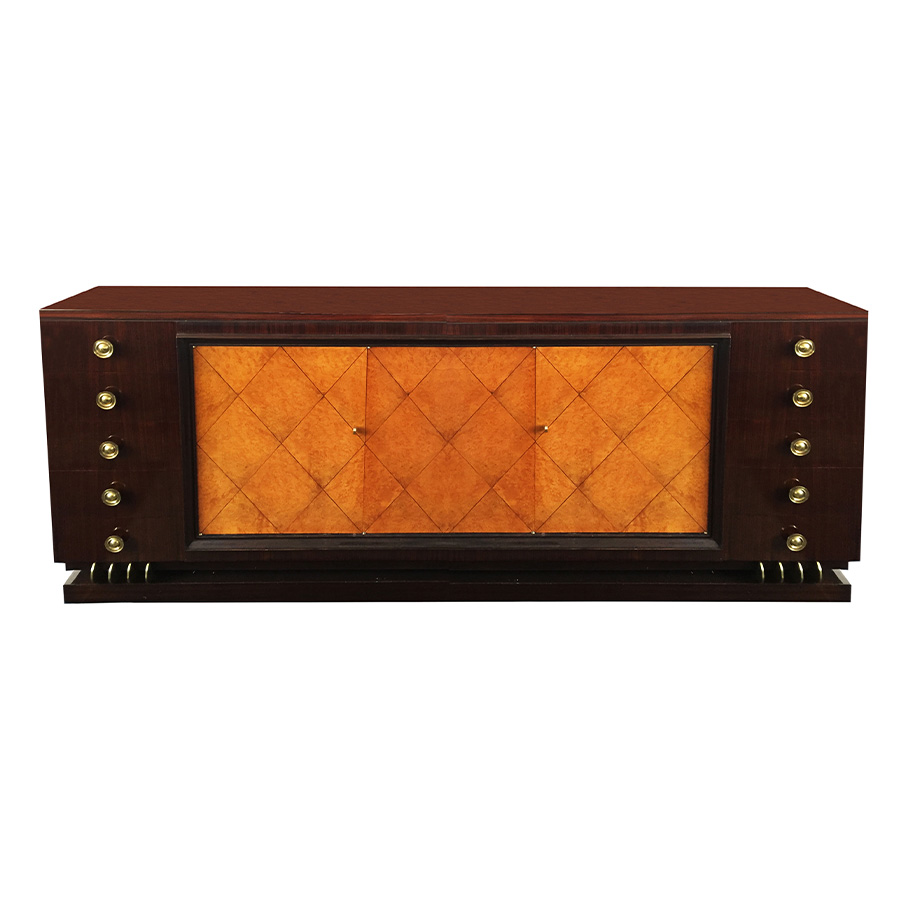
Art Deco took its name from the 1925 International Exposition of Modern Decorative and Industrial Arts in Paris and reached its height in the 1930s. It is a style of confidence. Forms are geometric and usually symmetrical, surfaces are polished, and materials are chosen to be seen: macassar ebony and burl veneers, hand-rubbed lacquer, brass and bronze, mirror and glass. The result is furniture that behaves like architecture, anchoring a room. For a fuller history, see our collector’s guide to what defines Art Deco, or the overview on Wikipedia.
In practice, authentic Art Deco rewards a specialist eye. Joinery, veneer matching and original hardware tell you more than any label. Our authentic Art Deco furniture collection is sourced and restored with provenance and period accuracy in mind.
What defines Mid-Century Modern?
Mid-Century Modern grew out of the postwar years, from the mid-1940s through the 1960s, shaped by modernist thinking, new manufacturing methods and a desire for homes that felt lighter and more open. The vocabulary is quieter than Deco. Legs taper, arms are slim, and curves are soft rather than stepped. Warm woods such as teak and walnut sit beside wool, tweed and other tactile fabrics. Ornament recedes; proportion and craftsmanship carry the design. The Wikipedia entry on Mid-Century Modern gives a helpful outline of its origins.
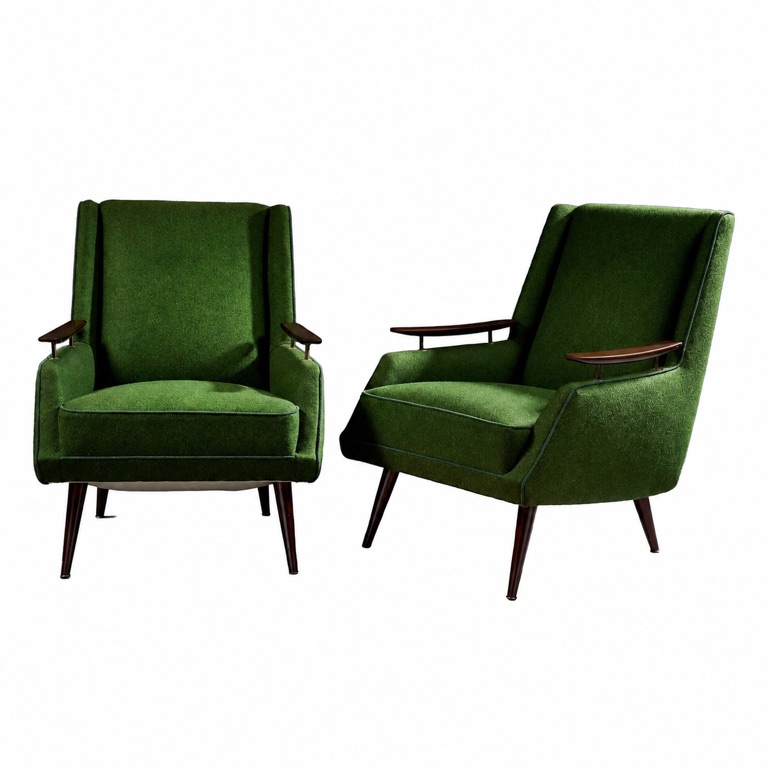
Our Mid-Century Modern collection brings together authentic period pieces chosen for their line, condition and character.
How to tell them apart in a showroom
When a piece is in front of you, three quick checks usually settle it.
1. Look at the silhouette
Art Deco is built from strong planes and stepped geometry. Mid-Century Modern floats: look for legs that taper and lift the piece off the floor, and edges that soften.
2. Look at the surface
A high-gloss, richly figured or lacquered surface with brass detail points to Deco. A matte oiled finish where you can read the grain points to mid-century.
3. Look at the ornament
If the decoration is part of the design, such as inlay, sunbursts or metal accents, think Deco. If the only ornament is the shape itself, think mid-century.
Period pieces can blur these lines, since some late Deco furniture is simpler and some early mid-century design still carries a trace of formality. A specialist can confirm the period and provenance of any piece you are considering.
Why the two work so well together
These styles are closer relatives than they first appear. Both reject fussy Victorian ornament. Both value fine materials and honest craftsmanship. Both reward a confident, uncluttered room. That shared outlook is what makes them easy to combine: the glamour of Deco gives a mid-century room a focal point, and the ease of mid-century keeps a Deco room from feeling like a period set.
How to mix them: six guidelines
Choose one lead style
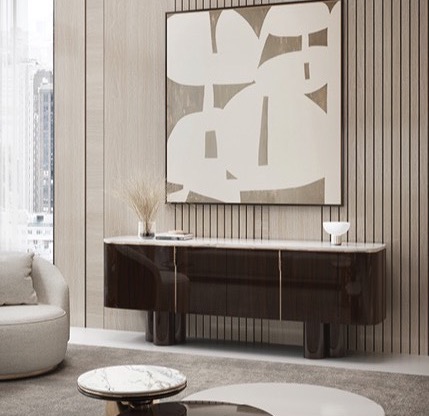
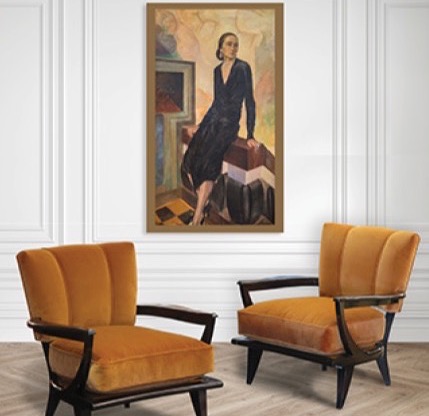
Let one era set the tone of the room and bring the other in as the counterpoint. A Deco sideboard with mid-century chairs reads as intentional. Half and half tends to read as indecision.
Anchor with a single statement piece
Give the eye one place to land, usually a sideboard, cabinet or mirror. Deco pieces are natural anchors because of their presence and symmetry.
Repeat one material across both
Brass, dark wood or a single upholstery color can run through both eras and quietly join them. A brass pull on a sideboard and brass in a floor lamp does the work of a bridge.
Mind the proportions
Deco pieces are often heavy and low. Mid-century pieces sit on slender legs. Pair a substantial case piece with lighter seating, and leave air around each so the shapes can be read.
Keep the palette calm
Let the furniture supply the richness. Quiet walls in warm neutrals, deep green or charcoal let both styles stand out without competing.
Edit, then edit again
The most convincing mixed rooms contain fewer pieces than you expect. If you are unsure whether something earns its place, it probably does not.
- Art Deco (1920s to 1930s) is glamorous, symmetrical and richly ornamented; Mid-Century Modern (mid-1940s to the 1960s) is relaxed, light and led by form and natural wood.
- Check silhouette, surface and ornament to tell a piece’s period at a glance.
- The two styles combine well when one leads, one statement piece anchors the room and a material is repeated across both.
- Authentic period pieces are best confirmed by a specialist who can speak to provenance.
Bringing both into one home
Many of our interior design clients ask for exactly this blend. A collector may begin with a Deco sideboard and add mid-century chairs over time. A designer may be building a living room around a lounge pair and want one pronounced case piece to give it weight. Our showroom in Los Angeles presents authentic pieces from both eras, so you can see how they sit together before you decide.
If your project calls for something that does not exist on the showroom floor, our separate Studio Line is made-to-order and fully customizable, with proportions, wood and finish chosen with you. It is a contemporary line in its own right and is designed alongside, not as a copy of, the period pieces.
Frequently asked questions
Can you mix Art Deco and Mid-Century Modern furniture?
Yes. Both styles favor quality materials and clean composition, which is why they pair well. Choose one to lead the room, add a single statement piece, repeat a material such as brass or dark wood, and keep the overall number of pieces restrained.
What is the main difference between Art Deco and Mid-Century Modern?
Art Deco (1920s to 1930s) is formal and decorative, with symmetry, geometric detail and luxurious materials. Mid-Century Modern (mid-1940s to the 1960s) is lighter and more informal, with tapered legs, soft curves, warm woods and little ornament.
Which style is better for a small room?
Mid-Century Modern pieces on slender legs let light and floor show through, so they tend to suit smaller rooms. A single Art Deco piece can still work well as a focal point, as long as it is given space.
Which woods are typical of each style?
Art Deco often features exotic veneers such as macassar ebony, rosewood and burl, along with lacquer and brass. Mid-Century Modern is associated with teak and walnut in matte or oiled finishes.
How do I know a piece is authentic and not a reproduction?
Look at construction, hardware, the age of the finish and the documented history of the piece. A specialist dealer can verify period and provenance. If you would like to know more about how we source pieces, see our frequently asked questions.
Explore both eras with Anne Hauck
Browse our authentic Art Deco and Mid-Century Modern collections, or tell us about the room you are planning. We work with interior designers and private collectors.
Art Deco collection Mid-Century collection Enquire or visit the showroomMore from the journal: What Defines Art Deco? A Collector’s Guide · Commissioning a Bespoke Dining Table: Woods, Inlay and Finishes Explained
Anne Hauck has specialized in Art Deco furniture since 1986, dealing in authentic French and Italian period pieces, sourced and restored, and creating bespoke Studio Line furniture for interior designers and private collectors. The showroom is at 8738 Melrose Avenue, Los Angeles. Anne Hauck pieces have been featured in leading design publications, including Architectural Digest, Elle Décor and Robb Report, and selected for film, including décor for Martin Scorsese’s The Aviator.